

Discover expert insights on caster wheels outdoor – from material selection (PU, nylon, rubber) to rust resistance and after-sales support. Boost your wholesale business with our proven tips.
Table of Contents
- Introduction: Market Value of Caster Wheels Outdoor
- Basic Knowledge of Caster Wheels Outdoor: Core Parameters for Procurement
- FAQs About Caster Wheels Outdoor for Wholesalers (with Communication Scripts)
- 2025 Market Trends of Caster Wheels Outdoor: Sourcing Directions
- Conclusion: Key Action Items for Wholesalers
Caster wheels outdoor are indispensable components across numerous industries, supporting smooth movement in harsh outdoor environments. From garden equipment like lawnmowers to logistics tools such as outdoor trolleys, their performance directly impacts operational efficiency and user satisfaction. For wholesalers, mastering the procurement and selection of caster wheels outdoor is the key to reducing after-sales disputes and improving customer loyalty.
1. Introduction: Market Value and Core Positioning of Caster Wheels Outdoor
- 1.1 Rigid Demands in Outdoor Scenarios: The application scope of caster wheels outdoor continues to expand, covering garden equipment (lawnmowers, pruning carts), logistics and warehousing (outdoor turnover carts, container auxiliary tools), camping gear (portable trolleys), and municipal engineering (road cleaning vehicles). Notably, different scenarios have distinct performance requirements for caster wheels outdoor.
- 1.2 Core Pain Points for Wholesalers: Common challenges include customer complaints due to improper material matching, after-sales disputes caused by inadequate rust resistance, and imbalanced inventory (overstock of slow-moving models while bestsellers are out of stock). This guide provides targeted solutions and sourcing logic.
- 1.3 Value of This Guide: It focuses on key procurement decision points, breaks down professional answers to frequently asked questions, and attaches reusable customer communication scripts – helping wholesalers quickly establish a professional image and increase conversion rates.
2. Basic Knowledge of Caster Wheels Outdoor: Core Parameters for Procurement
2.1 Core Classification: Divided by Functional Scenarios
- Heavy-Duty Caster Wheels Outdoor: Suitable for construction machinery (excavator accessory carts), airport ground equipment (luggage trailers), and port container handling equipment. Load capacity ranges from 1.2 to 5 tons, with brackets mostly forged from thick steel plates.
- Medium-Light Caster Wheels Outdoor: Adaptable to outdoor furniture (sunshade base, camping trolleys), hand trucks (express delivery carts, farmers’ market turnover vehicles), and cleaning equipment (outdoor floor scrubbers). Light-duty models support 25-150 kg, while medium-duty ones handle 150-500 kg.
- Special-Function Caster Wheels Outdoor: Customized outdoor-specific models with brakes (single/double brakes), shock absorption (rubber shock-absorbing ring design), anti-static (suitable for outdoor electronic equipment transportation), and anti-entanglement (wheel axle with grass guard, ideal for lawn scenarios).
2.2 Key Performance Indicators: Core Requirements for Outdoor Scenarios
- Weather Resistance: Adaptable to a wide temperature range (-30℃ to 60℃ as the common standard) and具备 UV aging resistance, ensuring no cracking or hardening after long-term exposure.
- Rust Resistance Level: Neutral salt spray test is the core standard – high-quality caster wheels outdoor resist rust for ≥720 hours, while ordinary ones for ≥480 hours. Surface treatment directly determines rust resistance.
- Sealing Protection: IP55 or higher waterproof and dustproof rating is required to effectively prevent rain erosion and sand intrusion into bearings, avoiding jamming and failure.
- Load Safety: Clarify the difference between dynamic load (when rolling) and static load (when stationary) – the former is usually 20% lower than the latter. Product labels should indicate the safety factor (≥1.2 is recommended).
3. FAQs About Caster Wheels Outdoor for Wholesalers (with Communication Scripts)
3.1 Material Selection for Caster Wheels Outdoor: Which Material Fits Best?
Q1: For caster wheels outdoor, should I choose PU, nylon, or rubber? What are their pros and cons?
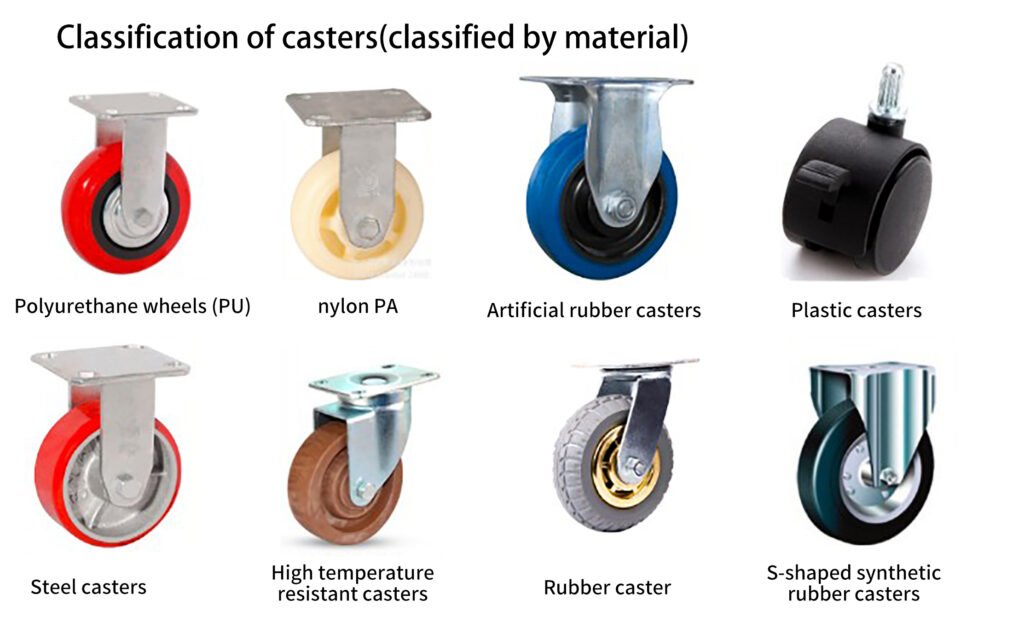
Polyurethane (PU): Optimal overall performance, with a Shore hardness of around 85A, balancing wear resistance and elasticity. Noise is below 60 dB, and load capacity reaches 1000 kg. Suitable for flat outdoor surfaces (scenic trails, warehouse exteriors, camping sites) and friendly to wooden floors and stone surfaces without scratches.
Nylon (PA): High hardness (Shore hardness 110D) and strong load capacity (heavy-duty models up to 5 tons), resistant to rough surfaces and acid-alkali corrosion. Ideal for extreme scenarios like mines, construction sites, and chemical parks, but with poor elasticity and high noise.
Rubber: Made of natural rubber, it offers excellent shock absorption and quiet operation (noise ≤45 dB) and resists low temperatures (-30℃ applicable). However, it ages easily under long-term exposure, suitable for short-term outdoor use or low-temperature environments (e.g., northern garden equipment in winter). Communication Script: “Recommend based on your customers’ core needs – PU for outdoor furniture and camping gear, nylon for engineering equipment and mining tools, and rubber for northern customers needing quiet and shock absorption. I’ll prepare a scenario matching table for you to send directly to customers, along with corresponding material test reports.”
Are stainless steel caster wheels outdoor always better than galvanized ones?
Not necessarily – it depends on the corrosive environment. 304 stainless steel caster wheels outdoor contain 8%-10% nickel, with excellent salt spray resistance (≥1000 hours), making them the first choice for coastal areas and marine equipment. However, their cost is over 40% higher than galvanized ones. Hot-dip galvanized caster wheels outdoor have a zinc layer thickness of 80-100 μm, with a salt spray test result of up to 480 hours, suitable for ordinary damp outdoor areas (courtyards, workshop exteriors, municipal green belts) with higher cost-effectiveness. Additionally, 201 stainless steel caster wheels outdoor are cheap but have poor rust resistance, not recommended for outdoor use. Communication Script: “Stock 304 stainless steel models if you have many customers in coastal areas and docks; promote hot-dip galvanized ones for inland customers with ordinary outdoor equipment needs. The price difference saves 15%-20%, and both meet national standards. You can tell the difference by sampling.”
3.2 Performance & Safety of Caster Wheels Outdoor: Key to Avoiding After-Sales Risks
How to calculate the load capacity of caster wheels outdoor? Is it the sum of four casters’ loads?
Outdoor ground is often gravelly and potholed, easily causing single-wheel suspension or uneven stress. Therefore, the actual safe load should be calculated as “the total load of three casters” – an industry universal standard. For example, four caster wheels outdoor marked with 250 kg load capacity each have a safe load of 750 kg instead of 1000 kg. If customers need to bear 1000 kg, choose models with single-wheel load capacity above 400 kg. Additionally, dynamic load (when rolling) is 20% lower than static load; it is particularly important to remind customers with frequently moving equipment to select based on dynamic load. Communication Script: “Be sure to clarify this safety calculation method to customers. Uneven outdoor ground can easily cause excessive stress on a single wheel and damage. This point is clearly stated in our after-sales terms, and I’ll help you include the calculation method in the contract appendix to avoid disputes later.”
How to judge the rust resistance of caster wheels outdoor? Are there any test standards?
Focus on two indicators and one certificate:
① Surface treatment process (priority order: 304 stainless steel > hot-dip galvanizing > electrophoresis > powder coating. Stainless steel can be simply identified by a magnet – 304 is non-magnetic, while 201 is slightly magnetic).
② Salt spray test duration (high-quality caster wheels outdoor resist rust for ≥720 hours under neutral salt spray, ordinary ones for ≥480 hours).
③ Authoritative test certificate – require manufacturers to provide test reports from institutions like National Institute of Metrology (NIM) and SGS, which should indicate test methods and results. Communication Script: “Each batch of goods is accompanied by a third-party salt spray test report with a CMA seal, ensuring no rust for 720 hours. Showing this to customers is more reliable than just saying ‘good rust resistance’ – customers can even use it for bidding.”
3.3 Procurement & After-Sales of Caster Wheels Outdoor: Practical Tips to Reduce Costs & Disputes
Q1: What about the MOQ and delivery time of caster wheels outdoor? How to deal with high freight costs in remote areas?
A1: MOQ varies by type: 50 sets for regular models (e.g., 4-inch PU wheels, 6-inch nylon wheels), which can be relaxed to 30 sets for old customers; 200 sets for customized models (special sizes, color powder coating, logo engraving). Pantone color numbers are required for color customization, and size tolerance is controlled within ±0.5 mm. Delivery time: 2-3 working days for small orders (≤100 sets), 7 working days for large orders (≥500 sets), and 1 working day for urgent orders (≤50 sets). Freight solutions for remote areas:
- Freight consolidation – unite with surrounding wholesalers for joint shipment, saving 30% compared to individual express delivery.
- Long-term cooperation with SF Express and Deppon Logistics enables 30% off freight for wholesale customers. Goods are delivered to logistics points by default; door-to-door delivery can be negotiated additionally. Communication Script: “Regular models have an MOQ of 50 sets, and 30 sets are acceptable for old customers. I’ll help you apply for expedited production for large orders. For remote areas, we use consolidated freight – I’ll coordinate logistics for you to reduce freight by another 5%, ensuring you have a profit margin of at least 20%. I’ll send you a video to confirm the quantity and appearance before shipment.”
Q2: What is the general warranty period? Which situations are not covered by the warranty?
A2: The industry’s regular warranty period is 12 months. For our caster wheels outdoor, we provide free replacement and cover round-trip freight for quality issues (bearing failure, bracket cracking, wheel surface falling off) during the warranty period. Situations not covered by the warranty are clearly defined:
- Overload use (exceeding the marked load by 20% or more).
- Incorrect installation (bracket deformation due to not fixing according to the manual).
- Chemical corrosion (contact with strong acids, alkalis, and other corrosive substances).
- Man-made damage (heavy impact, intentional disassembly). Cost-based repair services are available for these situations.
Communication Script: “You can rest assured with the 12-month warranty, but please inform customers of the usage specifications. Ask them to unpack and spot-check 2-3 sets upon receipt to inspect the wheel surface and brackets. Report any issues within 15 days after signing for receipt – I’ll respond and handle them within 24 hours; feel free to contact me if there’s any delay.”
4. 2025 Market Trends of Caster Wheels Outdoor: Sourcing Directions for Wholesalers
4.1 Demand Growth Points: ① Heavy-duty caster wheels outdoor, suitable for new energy outdoor operation equipment (solar panel cleaning vehicles, electric engineering vehicles), airport ground equipment, and port logistics equipment, with an annual growth rate of 18%. ② Customized caster wheels outdoor – color-customized and logo-engraved models for outdoor furniture brands, and lightweight customized models for camping gear, with a premium margin 25% higher than regular models.
4.2 Material Upgrade Directions: ① Weather-resistant PU – using imported polyether-based PU raw materials, UV aging resistance is improved by 30%, with no cracking after long-term outdoor use (more than 2 years). ② 316 stainless steel caster wheels outdoor, containing 2%-3% molybdenum, with chloride corrosion resistance 5 times that of 304 stainless steel, and demand in chemical and marine operation scenarios increasing by 22% annually. ③ Reinforced nylon wheels – adding 30% glass fiber, impact strength increased to 120 KJ/m², replacing some light-duty iron-core wheels.
4.3 Policy Dividends: Environmentally friendly caster wheels outdoor are becoming a trend. Recyclable PU (90% recycling rate) and lead-free electroplated caster wheels outdoor comply with EU REACH regulations and China’s “dual carbon” policy, accounting for 45% of government procurement and export orders. Early deployment of environmentally friendly models can seize market opportunities. For more environmental standards, you can refer to the EU REACH official website.
5. Conclusion: Key Action Items for Wholesalers of Caster Wheels Outdoor
- 5.1 Sourcing: Adopt the “scenario-material-performance” three-dimensional matching model for sourcing, and establish customer scenario files (e.g., coastal areas → 304 stainless steel + double brakes + IP55 sealing; engineering → glass fiber nylon + large diameter + double ball bearings; camping → lightweight PU + quiet wheels) to avoid blind stockpiling. For related product matching, you can browse our caster wheels product collection.
- 5.2 Communication: Replace vague statements with “data + cases”, create standardized communication tools (product parameter manuals, scenario matching tables, test report collections), and provide “sample + information package” combinations for new customers to enhance professionalism.
- 5.3 After-Sales: Establish a “pre-prevention + rapid response” mechanism, provide acceptance standards before shipment, follow up on usage feedback within 15 days after receipt, clarify the warranty scope in the contract, and sort out solutions for common problems in advance to reduce dispute rates.
Leave a Reply