

In numerous fields such as industrial production, warehousing and logistics, and office and home use, Industrial Caster serve as core mobile components whose performance directly impacts equipment operational efficiency, operational safety, and service life. However, amid the diverse range of caster products on the market, many users often face selection dilemmas—Why are stainless steel casters magnetic? How to accurately measure when replacing casters? What material of Industrial Caster should be chosen for different scenarios? As a global professional caster manufacturer, Goodich has crafted this comprehensive caster knowledge guide based on years of industry experience and technical expertise, covering full-dimensional content from basic understanding to advanced applications, helping you easily solve various caster application challenges.
I. Basic Understanding: Debunking Common Myths About Casters
1.1 The Magnetic Mystery of Stainless Steel Casters
“We received the wrong product! Why is the stainless steel caster I ordered attracted to a magnet?” This is a frequent inquiry received by Goodich’s customer service team. In fact, magnetism and stainless steel are not mutually exclusive—this misunderstanding stems from a lack of knowledge about stainless steel material classifications. The “rust-resistant” property of stainless steel is mainly imparted by chromium, while its magnetism depends on the internal atomic structure and alloy composition. When nickel is added to stainless steel, it forms a stable austenitic structure, resulting in non-magnetic characteristics. Such stainless steel is commonly used in magnetically sensitive environments such as MRI equipment and precision laboratories.
Goodich’s best-selling stainless steel casters are made of ferritic stainless steel. Due to containing no or very little nickel, this material retains the magnetic properties of iron, yet its rust resistance and mechanical strength fully meet industrial standards. It is suitable for most general scenarios such as food processing, warehousing, and logistics. If your application environment has strict requirements for non-magnetism, you can directly contact Goodich’s technical team, and we will customize an exclusive non-magnetic stainless steel caster solution for you.

1.2 Measuring Standard for Caster Hardness: Durometer
When selecting casters, parameters such as “Shore A Hardness” and “Shore D Hardness” often confuse users. In essence, a durometer is both a measuring tool and an indicator for evaluating the hardness of Industrial Caster treads. Its value directly reflects the caster’s wear resistance, load-bearing capacity, and floor adaptability.
Two scales are commonly used in the caster industry:
- Shore A: Suitable for low to medium hardness materials, with a range of 0-100 (higher values indicate greater hardness). For example, ordinary rubber bands have a hardness of approximately 25A, while Goodich’s commonly used polyurethane casters have a hardness between 85-95A—balancing excellent floor adhesion and wear resistance.
- Shore D: Used for materials exceeding the measurement range of Shore A. For instance, phenolic resin Industrial Caster can reach 90D, and hard safety helmets are around 75D.
Hardness is a key reference for Industrial Caster selection:
- For hard floors (e.g., hardwood, tiles), choose soft treads (70-85A) to avoid scratches.
- For rough surfaces (e.g., concrete, gravel), opt for hard treads (above 90A) to prevent premature wear.
All Goodich caster products clearly mark hardness parameters to help users accurately match their application scenarios.
1.3 Clarifying Confusing Materials: The Difference Between Semi-Steel and Full Steel
“Semi-steel” is a frequently used term in heavy-duty Industrial Caster selection. Many users mistakenly regard it as a type of steel, but semi-steel is essentially a special cast iron alloy—smelted by adding a large amount of scrap steel to cast iron raw materials. This material perfectly combines the advantages of cast iron and steel: it retains cast iron’s excellent castability, cost-effectiveness, and machinability, while the addition of scrap steel enhances its strength, impact resistance, and ductility, making it an ideal material for medium and heavy-duty casters.
Goodich’s semi-steel casters undergo a special heat treatment process, increasing their tensile strength by over 30% compared to ordinary cast iron casters. They are widely used in load-bearing scenarios such as industrial shelving and heavy equipment, offering far superior cost-effectiveness to full-steel casters.
II. Practical Guide: Accurate Methods for Industrial Caster Measurement and Replacement
2.1 Four Core Measurement Elements for Industrial Caster Wheels
When Industrial Caster wheels wear out but the brackets remain intact, accurate measurement is crucial for successful replacement. Goodich has summarized four core measurement dimensions—mastering these methods will help you quickly find the right replacement product.
- Wheel Diameter: Measure the maximum distance between the two sides of the wheel. Some wheels are directly molded or engraved with diameter markings; if not, measure manually. Note that long-term use can cause material wear of up to 0.5 inches, so severely worn wheels should be rounded up to the nearest half-inch size. Industrial Caster have high dimensional standardization, and an ordinary tape measure suffices for measurement.
- Bore Diameter: Refers to the internal diameter of the wheel’s central axle hole, directly determining whether the wheel can match the existing axle assembly. Higher measurement accuracy is required—we recommend using a micrometer or caliper. If no professional tools are available, test-fit drill bits of different sizes to find the exact match.
- Wheel Width: Measure the widest part of the tread material. While less critical than hub length, it provides important reference for matching similar products and can be measured with an ordinary tape measure. Note the distinction between tread width (narrower) and overall wheel width.
- Hub Length: The distance between the two sides of the wheel through the axle hole—this is the core parameter determining whether the wheel can fit the bracket. Incorrect hub length will cause the wheel to wobble or fail to install. Since a tape measure cannot reach inside the axle hole, insert a wooden stick or pencil into the hole, align one end with the wheel side, mark the other end, and then measure the marked distance.
Mastering these four elements allows you to easily find a precise replacement wheel. If you encounter difficulties during measurement, watch Goodich’s official video tutorial How to Measure Industrial Caster Sizes or contact customer service for one-on-one guidance.
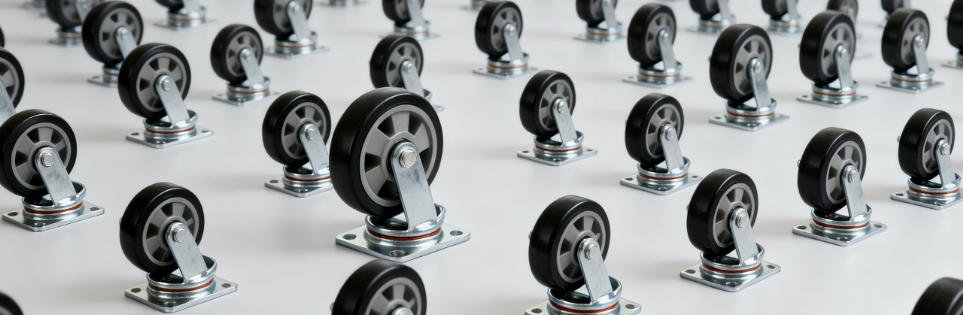
2.2 Chair Caster Replacement Tips: From Stem Size to Scenario Matching
Low-cost plastic casters standard on office chairs often experience jamming or floor scratching. Replacing them with high-quality Industrial Caster significantly improves usability. Goodich advises following the principle: “First confirm the stem specification, then match the application scenario.”
First, remove the stem of the existing Industrial Caster and confirm its specification using Goodich’s Industrial Caster Stem Measurement Guide. Industrial Caster stems come in various types (imperial or metric standards), so accurate measurement is a prerequisite for successful replacement. Second, select the tread material based on the floor type:
- Low-pile carpets: Nylon or metal wheels.
- Hard floors (especially hardwood, glass): Soft treads such as neoprene, thermoplastic elastomer (TPE), or polyurethane. Rubber wheels are quiet but may leave black marks, while polyurethane wheels perfectly balance noise reduction and scratch resistance.
Beyond functional requirements, you can choose hooded or unhooded designs based on aesthetic preferences, or even customize Industrial Caster in special colors like Windsor vintage or bright copper to add personality to office furniture. Goodich offers a full range of office chair Industrial Caster, from basic models to custom options—details are available in the online product catalog or by contacting the sales team.
III. Product Classification: Scenario-Based Industrial Caster Solutions
3.1 Pneumatic Wheels: Ideal for Rough Terrains
Pneumatic wheels stand out in outdoor and complex environments due to two core advantages:
- Superior shock absorption: Their inflatable structure effectively absorbs vibrations, protecting transported items from damage caused by jolts—ideal for rough surfaces such as rocks, concrete, soil, and grass.
- Extreme quiet operation: Maintains low noise even on uneven roads, suitable for noise-sensitive environments like warehouses and hospitals.
Goodich’s pneumatic wheels offer rich customization options:
- Choose tubed or tubeless designs based on application needs.
- Multiple bearing types and sizes to fit different Industrial Caster brackets.
- Tread patterns include smooth, striped, diamond, serrated, and lugged to meet anti-slip requirements for various surfaces.
Whether for garden tools, outdoor equipment, or heavy-duty logistics vehicles, you can find the right pneumatic wheel solution.
3.2 Kingpinless Casters: Safety Assurance for Heavy-Duty Scenarios
The kingpin is a core component of traditional swivel casters—essentially a rivet connecting the top plate and bracket, enabling swivel via ball bearings. However, under high-stress scenarios such as impact loads, the kingpin is prone to bending or breaking, leading to ball detachment and caster failure—making it a weak point of traditional Industrial Caster.
Kingpinless casters eliminate this weak point through precision machining and structural optimization, achieving a kingpin-free swivel design. They can withstand strong impacts and heavy stress without damage, significantly enhancing operational safety and durability. Note that kingpinless casters are primarily suitable for heavy-duty and extra-heavy-duty scenarios; traditional kingpin casters remain competitive in light and medium-duty applications due to cost advantages.
Goodich’s Industrial Caster adhere to military-grade manufacturing standards, with strict quality control from raw material selection to finished product inspection. They are suitable for extreme scenarios such as mining equipment and heavy machinery—relevant product information is available in the official online catalog.
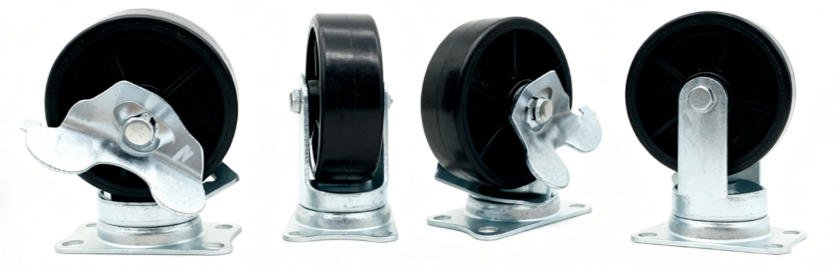
3.4 Flat-Free Foam-Filled Tires: Say Goodbye to Flat Tires
Flat-free foam-filled tires are upgraded alternatives to pneumatic wheels. Filled with a polyurethane foam matrix instead of air, they retain the flexibility, shock absorption, and easy rolling of pneumatic wheels while completely solving puncture issues—even if the tread is pierced, the tire will not go flat, greatly reducing maintenance costs.
These tires are particularly suitable for warehouse floors with metal shavings or staples, or scenarios requiring high maintenance convenience. They are widely used in hand trucks, wheelbarrows, logistics trolleys, and other equipment. Although slightly more expensive than pneumatic wheels, they offer significant long-term maintenance cost advantages. Goodich provides various specifications of flat-free foam-filled tires, supporting custom sizes and materials based on equipment models.
3.5 Custom Industrial Caster: Exclusive Solutions for Special Needs
Standardized Industrial Caster on the market meet most requirements but often fall short in special projects—whether it’s a custom stem for a unique chair or an extra-large load-bearing wheel for mining equipment. This is where Goodich’s customization service plays a key role.
Goodich’s custom Industrial Caster service process is concise and efficient:
- Customers specify project requirements via phone or email. Goodich engineers ask targeted questions (e.g., “On what type of surface will the wheel roll?” “Are there high-speed operations or lateral forces?”) to determine if customization is truly necessary, avoiding resource waste.
- Once customization is confirmed, both parties jointly finalize all parameters from the top plate and stem to the tread.
- Customers can provide drawings, samples, or images to assist communication, ensuring accurate transmission of requirements.
- Goodich’s design team, mechanics, and assemblers collaborate on production, providing progress updates throughout the process.
IV. Scenario Focus: Professional Applications of Pallet Truck Wheels and Heavy-Duty Cart Wheels
4.1 Pallet Truck Wheels: Core Factors Affecting Logistics Efficiency
Pallet trucks are core equipment in warehouse and factory logistics. Whether manual hydraulic pallet trucks or electric pallet trucks, the performance of their wheels directly determines transportation smoothness, safety, and efficiency. High-quality pallet truck wheels offer multiple advantages:
- Low rolling resistance reduces operator fatigue.
- High-strength wheel cores and tread materials prevent deformation under heavy loads.
- Floor-adapted material designs balance traction and floor protection.
Due to constant contact with the ground and exposure to impacts, dust, and chemicals, wheels are the fastest-wearing components on pallet trucks. Therefore, B2B buyers prefer partners that offer consistent batch quality, controllable pricing and lead times, rich material options, and compatibility with mainstream brands—Goodich is precisely such a professional supplier.
4.1.1 Core Characteristics of High-Quality Pallet Truck Wheels
Industrial buyers and maintenance teams evaluate pallet truck wheels based on the following technical factors:
- Tread Material: The key determinant of wear life, noise level, floor protection, and load-bearing capacity.
- Polyurethane (PU): Quiet, floor-friendly, and durable—suitable for indoor warehouses and epoxy floors.
- Nylon: High strength and low rolling resistance—ideal for heavy loads, cold storage, and outdoor scenarios.
- Rubber: Strong grip and quiet operation—suitable for retail and light-duty pallet trucks.
- Steel-core polyurethane: Combines extreme durability and high load-bearing capacity—perfect for heavy industry and logistics hubs.
- Load-Bearing and Dynamic Load Capacity: Single-wheel dynamic load capacity typically ranges from 150-500 kg, depending on the pallet truck’s rated load. Reputable suppliers provide tested load ratings with safety margins, validated through tens of thousands of dynamic load tests. Steel cores or high-density nylon are reliable choices for heavy-duty scenarios.
- Bearing and Hub Design: Deep groove ball bearings, sealed bearings, and precision-machined hubs reduce rolling resistance, minimize heat generation during continuous operation, and enhance the performance of both manual and electric pallet trucks.
- Geometric Dimensions:
- Wheel diameter affects passability over floor joints, small obstacles, and damaged surfaces.
- Wheel width and tread thickness determine contact area, wear patterns, and ground pressure.
- Dimensions must strictly match the fork tips and wheel housings of different pallet truck brands. Goodich wheels follow standardized sizes while supporting customization for special models.
4.1.2 Manufacturing and Service Advantages of Goodich Pallet Truck Wheels
Goodich’s factories utilize automated injection molding and casting production lines, combined with CNC-machined hubs and precision boring processes, ensuring precise wheel size compatibility. Each batch of products undergoes:
- Over 50,000 dynamic load tests.
- Dimensional and concentricity inspections.
- Random sampling for impact and wear simulations.
For OEM customers and distributors, Goodich offers comprehensive customization support:
- Customizable wheel diameter, tread width, hub size, color, hardness, and tread pattern.
- Branded packaging, private labeling, and document support.
- Perfect compatibility with international mainstream pallet truck brands.
Leveraging vertical integration and mass production advantages, Goodich delivers engineering-grade quality at competitive prices, making it an ideal long-term partner.
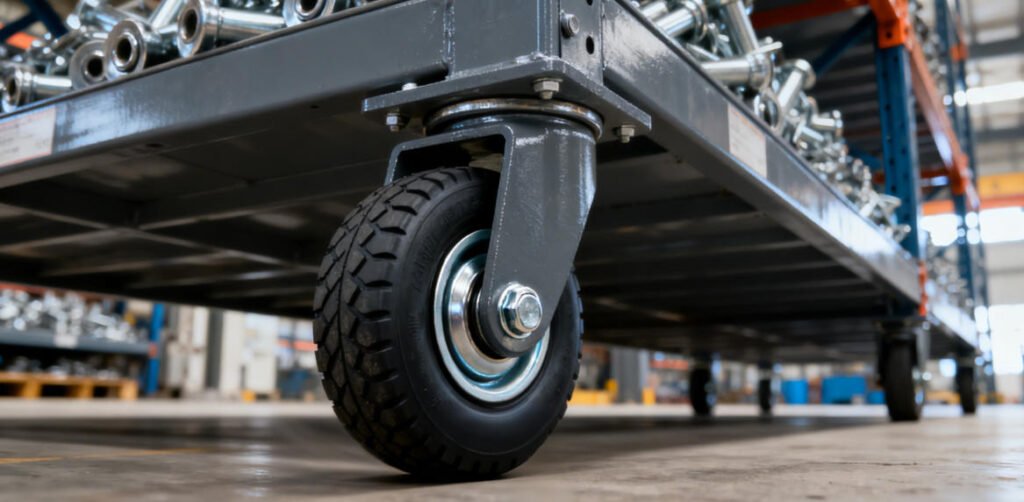
4.2 Heavy-Duty Cart Wheels: Load-Bearing Core for Industrial Transportation
Heavy-duty cart wheels are critical components supporting industrial trolleys, platform carts, material handling vehicles, and workshop transport equipment. Compared to standard wheels, they feature reinforced cores, industrial-grade bearings, and wear-resistant treads, enabling stable movement under harsh working conditions. Widely used in manufacturing plants, warehousing and logistics, construction sites, assembly lines, and commercial facilities, their market demand continues to grow as industries pursue higher efficiency and mobility.
4.2.1 Core Characteristics of Industrial Heavy-Duty Cart Wheels
High-performance heavy-duty cart wheels offer multiple engineering advantages to meet industrial transportation needs:
- High load-bearing strength: Single-wheel load capacity ranges from 150-1500 lbs, depending on size, material, and structural reinforcement.
- Durable tread materials: Polyurethane, nylon, rubber, and steel-core polyurethane ensure excellent wear resistance and long-term stability.
- Industrial-grade steel brackets: Thick steel frames resist bending, impact, and mechanical stress.
- Low rolling resistance: Precisely designed tread geometry and high-quality bearings ensure easy pushing even under heavy loads.
- Impact resistance: Engineered structures withstand repeated impacts from uneven surfaces or heavy-duty logistics operations.
- Floor adaptability: Compatible with epoxy floors, concrete, paved roads, and outdoor areas.
4.2.2 Material Selection and Type Classification
Different materials of heavy-duty cart wheels suit different industrial environments—select based on specific scenarios:
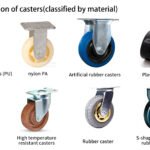
| Material | Performance Features | Application Scenarios |
| Polyurethane (PU) | Quiet, wear-resistant, floor-friendly | Indoor logistics, factory floors, commercial spaces |
| Nylon | High strength, low rolling resistance | Warehousing, heavy-duty platform carts |
| Rubber | Quiet, high grip, good shock absorption | Medical, hotel, office carts |
| Cast Iron + Polyurethane | High load-bearing, long service life | Heavy machinery, construction equipment |
| TPR (Thermoplastic Rubber) | Quiet, mark-free, smooth rolling | Medical carts, laboratories, clean rooms |
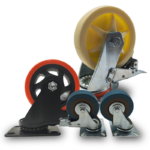
Structurally, heavy-duty cart wheels are classified into:
- Swivel casters (360° rotation): Suitable for flexible operation in tight spaces.
- Fixed casters: Ideal for stable linear transportation.
- Locking casters: Available with total lock, side lock, or directional lock for safe parking.
- Low-profile heavy-duty wheels: Meet height restrictions while ensuring high load-bearing capacity.
Choose based on operational requirements.
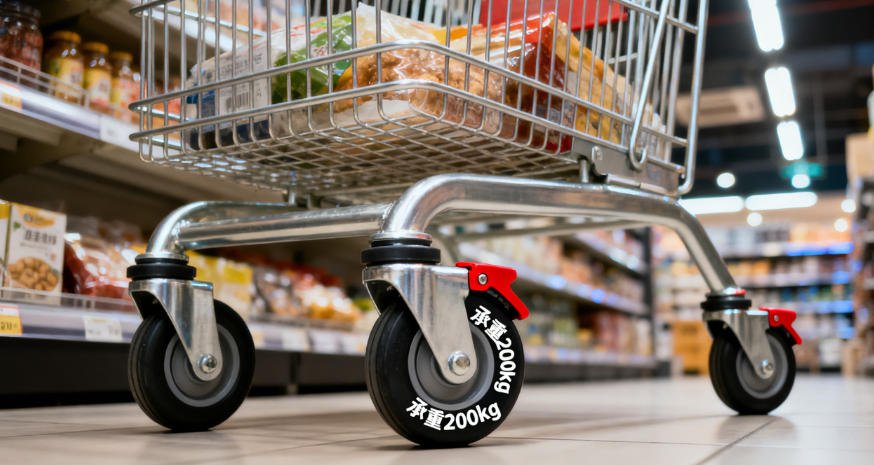
4.2.3 Selection and Services for Goodich Heavy-Duty Cart Wheels
To help users select the right products, Goodich provides a professional buying guide:
- Calculate load requirements: Use the formula “Total weight ÷ 4 × 1.3 (safety factor)” to ensure sufficient load-bearing capacity.
- Match floor type: Polyurethane/TPR for smooth floors; nylon/steel-core polyurethane for rough concrete; rubber/TPR for indoor quiet needs.
- Determine locking needs: Choose total lock, directional lock, or non-locking designs based on safety requirements.
- Select wheel diameter: Common sizes include 5-inch, 6-inch, 8-inch, and 10-inch—larger diameters offer better obstacle clearance.
- Evaluate environmental adaptability: Select materials based on oil, water, temperature, and corrosion conditions.
- Prioritize bearing quality: Precision bearings are recommended for high-frequency or heavy-duty applications.
As a professional manufacturer, Goodich operates automated stamping, CNC machining, welding, and injection molding production lines, enabling mass production of polyurethane, nylon, rubber, TPR, and steel-core polyurethane wheels. Customization options include wheel diameter, tread hardness, bracket thickness, and color. Each batch undergoes:
- 100% load testing and rotation inspection.
- Over 50,000 dynamic fatigue tests.
- Salt spray corrosion resistance testing.
- Long-term stability verification under simulated working conditions.
For global distributors and equipment manufacturers, Goodich offers comprehensive OEM/ODM services, including custom logos, packaging, sizes, materials, and installation methods, ensuring stable lead times and global logistics support. We are a trusted heavy-duty cart wheel supplier for industrial customers worldwide.

V. Goodich: A Globally Trusted Provider of Caster Solutions
5.1 Brand Strength and Technical Advantages
With years of deep involvement in the Industrial Caster, Goodich has become the preferred partner for customers in over 30 countries and regions worldwide, thanks to its precise grasp of material properties, advanced manufacturing processes, and customer-centric service philosophy. Whether standardized industrial casters or customized special solutions, Goodich leverages integrated supply chain resources and a professional engineering team to ensure products perfectly match customer needs.
To help users quickly master caster knowledge and usage skills, Goodich has launched a series of official video tutorials, including How to Replace a Clip Stem, Caster Stem Measurement Methods, and Selecting Safe Casters for Solid Wood Floors. All videos are filmed on-site by Goodich sales representatives and technical personnel, providing intuitive solutions to the most common user problems. View the full series on the official video page.
5.2 Customer Support and Contact Channels
Whether you are an end-user needing to replace a single caster or an OEM manufacturer seeking long-term cooperation, Goodich provides professional support. For product inquiries, custom solutions, or technical assistance, contact us via:
- Consultation Hotline: +86-15618525178
- Email: info@goodich-hardware.com
Goodich is committed to providing reliable support for every movement with high-quality products, professional technology, and attentive service—becoming your long-term partner in Industrial Caster applications.
Leave a Reply