



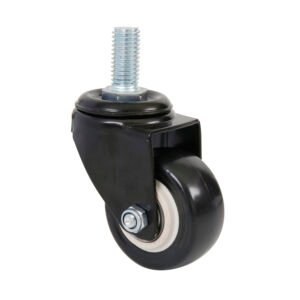
Swivel Caster — Heavy Duty Industrial Caster Wheels
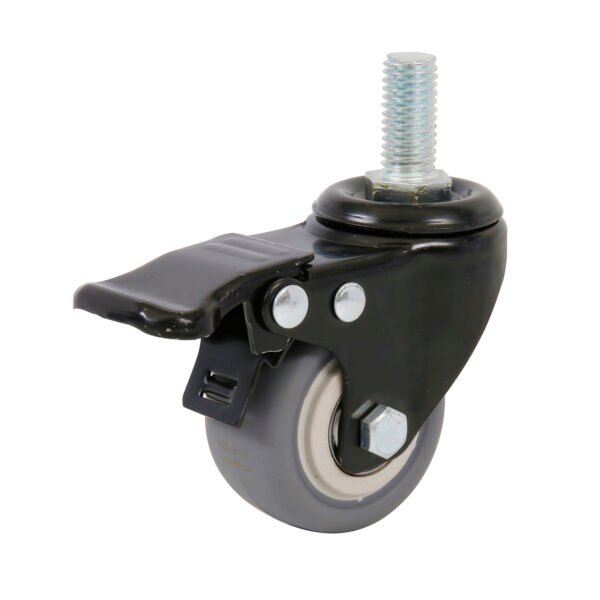
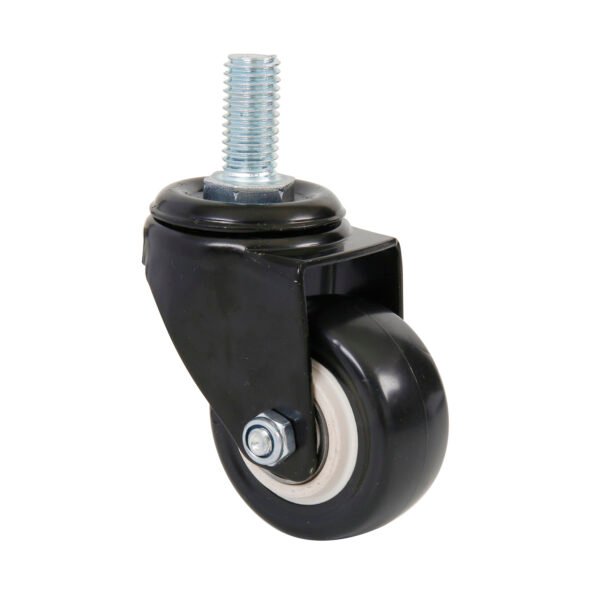
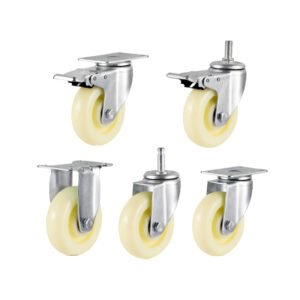
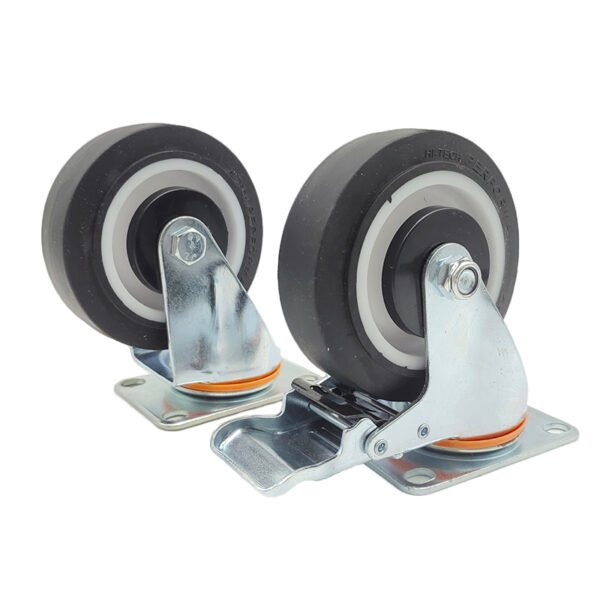
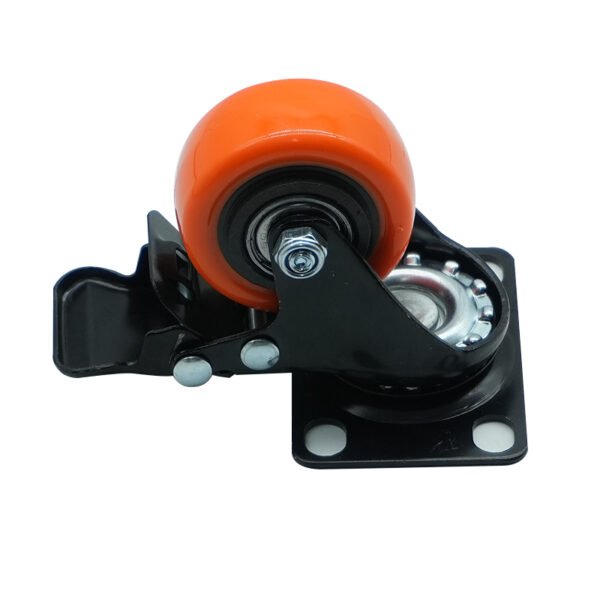
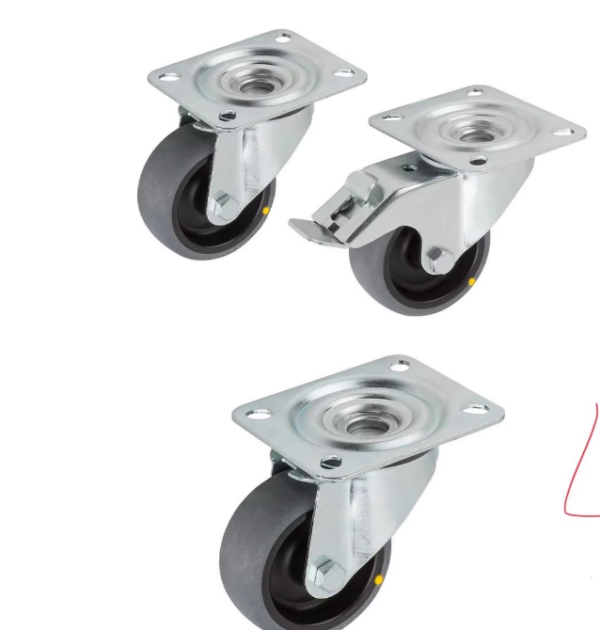
A swivel caster is a wheel assembly mounted on a rotating top plate or stem, allowing 360° directional movement. Unlike rigid casters that only roll forward and backward, swivel casters let operators steer carts, equipment, and material handling units in any direction — essential for tight aisles, busy production floors, and any environment where maneuverability matters more than straight-line speed.
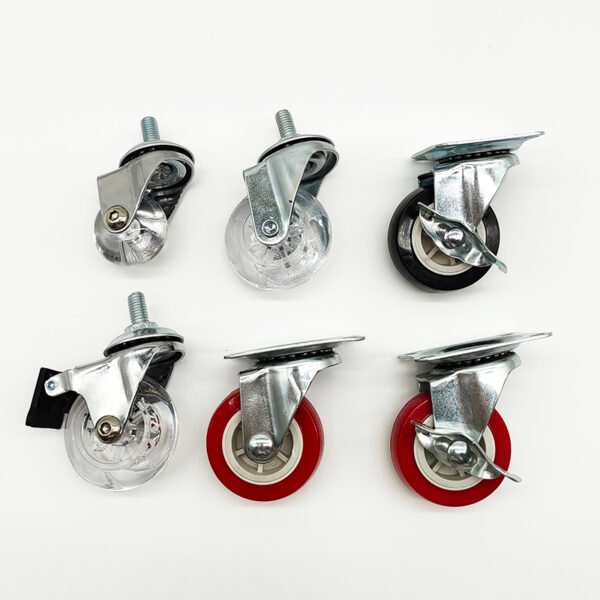
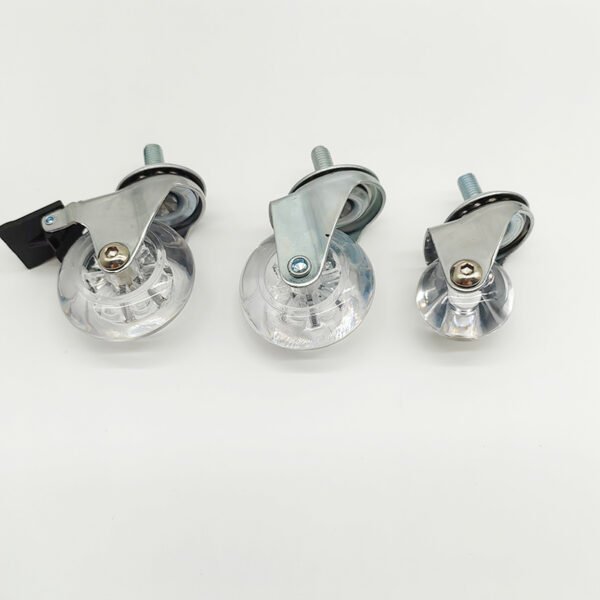
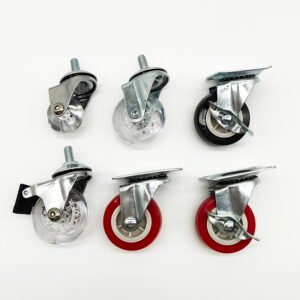
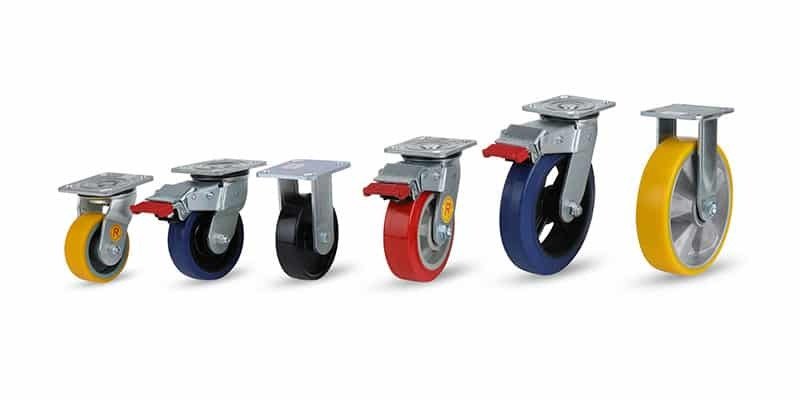
C&C Panel manufactures industrial swivel casters across a full load range — 16 kg light-duty units for office and retail, up to 650 kg heavy-duty units for factory floors and warehouse logistics. Every model is available with five different wheel materials, with or without integrated brake systems, and with top plate or threaded stem mounting.
This page covers our complete swivel caster range. For loads above 650 kg, see our heavy-duty rigid caster series.
Specifications
| Parameter | Range |
|---|---|
| Load capacity (per caster) | 16 – 650 kg |
| Wheel diameter | 50 mm – 200 mm |
| Wheel materials | Nylon, Polyurethane (PU), Rubber, Cast iron / Steel, Polypropylene (PP) |
| Rotation | 360° swivel |
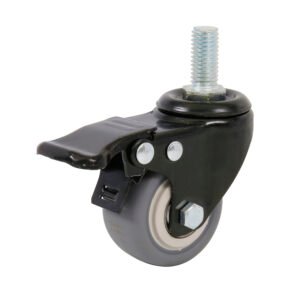
| Brake options | No brake / Top lock / Total lock (brake + swivel lock) |
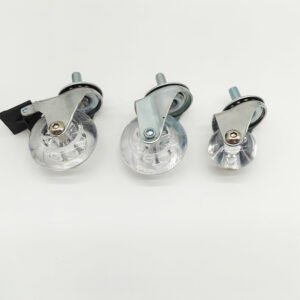
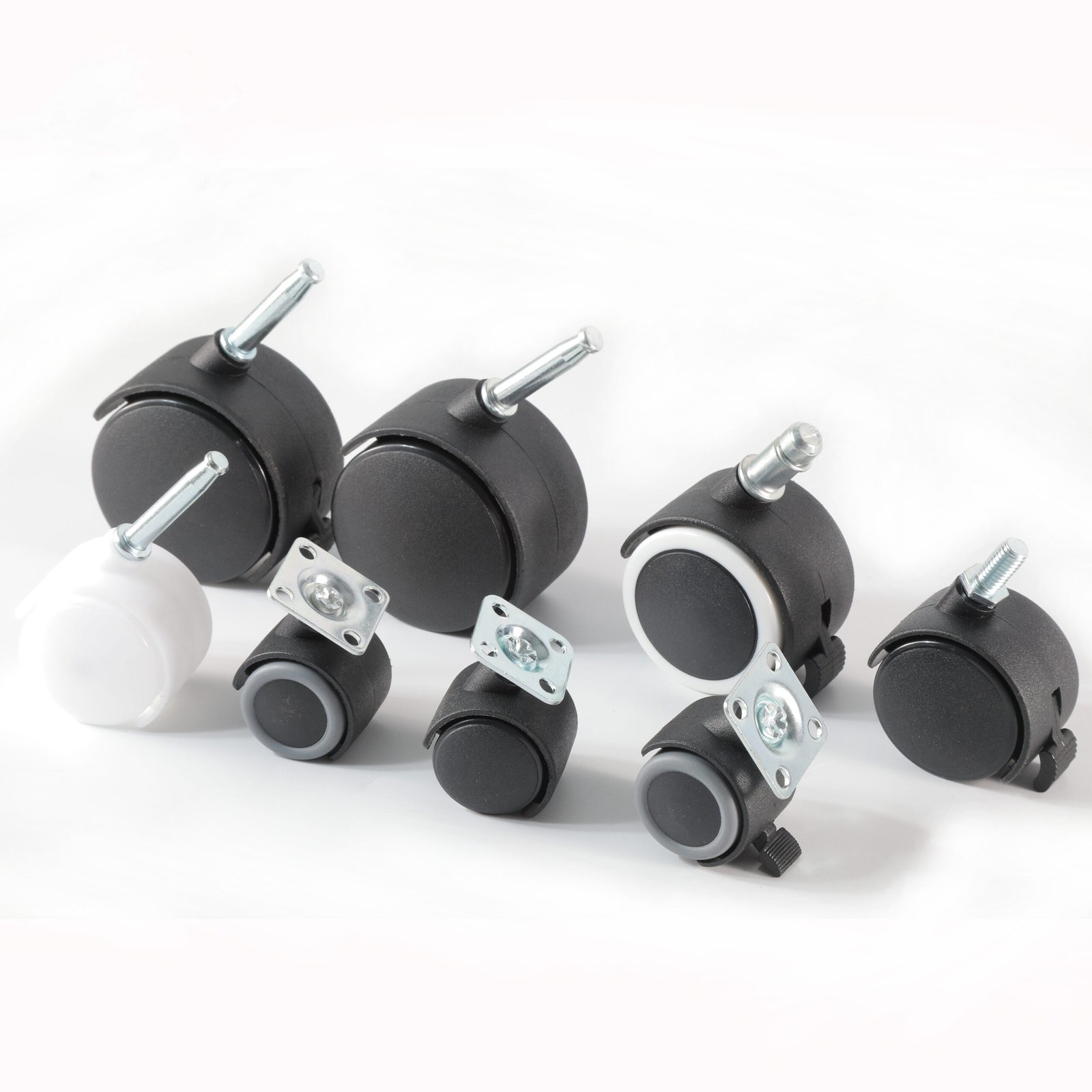
| Mounting | Top plate or threaded stem |
| Bearing | Double ball bearing (standard), roller bearing (heavy-duty grades) |
| Operating temperature | -20°C to +80°C (material dependent) |
| Top plate dimensions | Customizable to customer bolt pattern |
Wheel Material Selection Guide
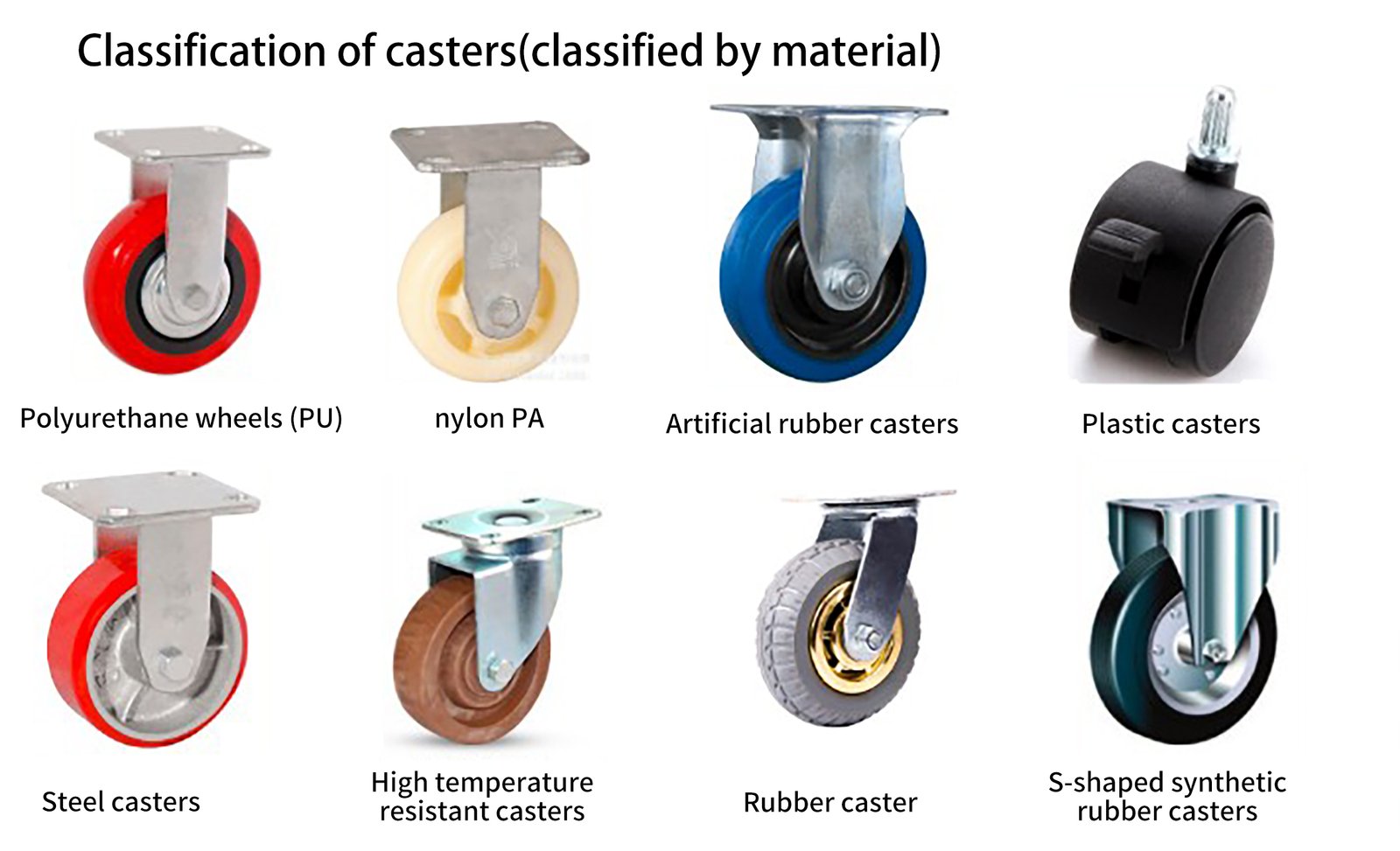
The wheel material is the single most important specification on a swivel caster. The wrong material destroys the floor, fails under load, or wears out in months. Use this matrix to specify correctly.
Nylon Wheels — Versatile & Impact-Resistant
Best for: Indoor and outdoor hard floors, warehouses, distribution centers, general industrial use.
Nylon wheels offer high abrasion resistance, strong impact tolerance, and a low rolling resistance that reduces operator fatigue on heavy carts. They handle debris-strewn floors without flat-spotting and survive long roll distances. The trade-off is noise — nylon is harder than PU or rubber and runs louder on concrete.
- Load capacity: up to 500 kg
- Hardness: ~75 Shore D
- Service temperature: -30°C to +80°C
Polyurethane (PU) Wheels — Silent & Floor-Friendly
Best for: Polished floors, hospitals, laboratories, precision equipment, electronics assembly, retail showrooms.
PU wheels run quietly, leave no marks, and protect finished floor surfaces. They combine the cushioning of rubber with the load capacity of harder plastics. PU is the standard choice anywhere noise, floor preservation, or operator comfort matters — medical carts, server racks, audio-visual equipment, precision instruments.
- Load capacity: up to 500 kg
- Hardness: 85–95 Shore A
- Service temperature: -20°C to +70°C
Rubber Wheels — Shock-Absorbing & High-Grip
Best for: Uneven floors, outdoor surfaces, fragile cargo, transport carts where vibration damping is critical.
Rubber wheels provide the best vibration absorption and floor grip in the lineup. They protect delicate loads from shock and stay stable on textured or slightly uneven surfaces. The limitation is lifespan — rubber ages, hardens, and cracks faster than synthetic materials, especially under UV exposure or chemical contact.
- Load capacity: up to 200 kg
- Hardness: 65–75 Shore A
- Service temperature: -20°C to +60°C
Cast Iron / Steel Wheels — Maximum Load Capacity
Best for: Heavy industrial machinery, foundries, hot environments, ovens, kilns, heavy-load transfer equipment.
Cast iron and steel wheels carry the highest loads in any swivel caster category and tolerate high-temperature environments where polymer wheels would soften or degrade. The trade-off is significant: steel wheels can damage finished floors and run noisily. They are specified only where load and heat resistance override all other concerns.
- Load capacity: up to 650 kg (swivel configuration)
- Service temperature: up to +280°C (depending on bearing grade)
PP (Polypropylene) Wheels — Chemical Resistant
Best for: Chemical plants, pharmaceutical production, food processing, cleanrooms, wash-down environments.
PP wheels resist a broad range of acids, alkalis, and solvents that would degrade nylon, PU, or rubber. They are lightweight, easy to clean, and economical for environments where chemical exposure is the primary concern rather than maximum load.
- Load capacity: up to 200 kg
- Hardness: ~70 Shore D
- Service temperature: -10°C to +80°C
- Chemical resistance: resistant to most acids, alkalis, and salt solutions

Load Capacity Range — Choose the Right Class
C&C Panel swivel casters are organized into four load classes. Specify by the weight per caster, not the total cart weight (a four-caster cart distributes load across four units, but always size for three casters carrying the load in case one lifts during turning).
| Class | Per-Caster Load | Wheel Diameter | Typical Applications |
|---|---|---|---|
| Light-duty | 16 – 160 kg | 50 – 100 mm | Office chairs, retail fixtures, light service carts, AV equipment |
| Medium-duty | 100 – 300 kg | 75 – 125 mm | Hospital beds, hotel housekeeping carts, food service trolleys, light industrial |
| Heavy-duty | 160 – 650 kg | 100 – 200 mm | Factory material handling, warehouse picking carts, machinery moving, AGV platforms |
| Super heavy-duty | 270 – 800+ kg (rigid only) | 150 – 200 mm | Heavy machinery transfer — see our rigid caster series |
For loads above 650 kg per caster, swivel configurations are not recommended — the rotational stress on the kingpin under heavy load shortens service life. Specify rigid casters for the load-bearing positions and swivel casters for the steering positions.
Brake Options
Three brake configurations are available across the swivel caster range:
No brake — pure 360° rotation, no locking. Used where the cart is always in motion or held stationary by external means (docking station, ramp).
Top lock (wheel brake) — a foot-activated pedal locks the wheel from rolling but allows the swivel head to rotate. Useful for temporary positioning where the cart may still need to be turned.
Total lock (brake + swivel lock) — locks both the wheel and the swivel head simultaneously. The cart is fully immobilized in position and direction. Required for medical equipment, workstation carts, and any application where the cart must not drift or rotate when loaded.
All brake mechanisms are corrosion-resistant zinc-plated steel and rated for the same load as the caster itself.
Application Scenarios
C&C Panel swivel casters are deployed across the full range of B2B operating environments:
- Manufacturing & factories — material handling carts, work-in-progress trolleys, tool carts, assembly line fixtures
- Warehousing & logistics — picking carts, order consolidation, AGV platforms, dock equipment
- Medical & healthcare — hospital beds, instrument carts, IV stands, mobile diagnostic equipment (PU wheels, total lock)
- Hospitality — housekeeping carts, room service trolleys, luggage carts, banquet equipment
- Food service & retail — display fixtures, food trolleys, mobile point-of-sale, stock carts
- Chemical & pharmaceutical — PP wheels for acid / alkali environments, cleanroom-compatible configurations
- Heavy industry — foundries, steel mills, kilns (cast iron wheels for high-temperature zones)
- Office & commercial — chair bases, mobile pedestals, AV equipment, modular furniture
For each scenario, our engineering team can specify the optimal combination of wheel material, load class, brake configuration, and mounting style. Request a consultation through the form below.

Why Choose C&C Panel
Direct from manufacturer. C&C Panel operates an integrated production facility — no trading-house markup, no third-party QC gap. Every caster ships from one factory under one quality system.
Five wheel materials, one supplier. Specify nylon, PU, rubber, cast iron, or PP from the same product line, with matched top plates and bolt patterns. Simplifies procurement and color/size matching across a mixed fleet.
Full load range 16–650 kg. From light office casters to heavy-duty 650 kg industrial units, ordered from a single catalog. No need to split orders across multiple suppliers.
Customization on request. Top plate dimensions, bolt patterns, threaded stem sizes, brake configurations, and wheel-tread variants are all customizable for OEM and project orders. MOQ negotiable for ongoing partnerships.
Export-ready documentation. REACH, RoHS, and load test reports available for each grade. Experienced shipping to North America, Europe, Southeast Asia, the Middle East, and Australia.
Frequently Asked Questions
Q: What is a swivel caster? A swivel caster is a wheel assembly mounted on a rotating bearing, allowing the wheel to rotate 360° in any direction. This lets carts and equipment be steered freely, unlike rigid casters which only roll in a straight line.
Q: What is the difference between swivel and rigid casters? Swivel casters rotate 360° for steering. Rigid casters roll only forward and backward. Most carts use two of each — rigid casters at one end for stability, swivel casters at the other end for steering.
Q: How much weight can a swivel caster hold? C&C Panel swivel casters carry from 16 kg (light-duty) up to 650 kg (heavy-duty) per caster. Always size by per-caster load, calculated as total cart weight divided by three (not four), to account for uneven floor distribution.
Q: What is the best swivel caster for heavy loads? For loads of 300–650 kg per caster, specify nylon or cast iron wheels in our heavy-duty class, with double ball bearings or roller bearings and a reinforced top plate. For loads above 650 kg per caster, switch to rigid casters in the load-bearing positions and use swivel casters only for steering.
Q: Do swivel casters need to be locked? Only if the cart must stay stationary when loaded or unloaded. For stationary work — hospital beds, workstation carts, medical equipment, retail displays — specify total lock brakes. For carts that are always in motion, no brake is needed.
Q: How do I choose the right swivel caster? Five questions decide the spec: (1) per-caster load, (2) floor surface, (3) operating environment (dry / wet / chemical / high-temperature), (4) whether locking is required, and (5) mounting style (top plate or threaded stem). Contact our engineering team with these five answers and we will recommend the exact model.
Q: What size swivel caster do I need? Larger wheel diameters roll more easily over obstacles and reduce operator effort but increase overall cart height. Light-duty: 50–100 mm. Medium-duty: 75–125 mm. Heavy-duty: 100–200 mm. When in doubt, go one size up — operator fatigue from undersized wheels is the most common complaint in material handling.
Q: How long do swivel casters last? Service life depends on load, floor condition, and wheel material. Under correct specification and normal industrial use, expect 3–7 years for PU and nylon, 2–4 years for rubber, and 5–10+ years for cast iron. Overloading and incorrect floor matching are the two most common causes of premature failure.
Q: Are swivel casters available with brakes? Yes. Three configurations: no brake, top lock (wheel only), and total lock (wheel + swivel head). All three are available across the full load range and all five wheel materials.
Q: Can I order custom swivel casters? Yes. Top plate dimensions, bolt patterns, stem sizes, wheel treads, and brake configurations are all customizable for OEM and project orders. Standard MOQ applies, with flexibility for ongoing accounts.
Request Samples or a Quotation
Tell us your load requirement, floor surface, and application — we will recommend the exact specification within 24 hours.
Email: info@goodich-hardware.com
WhatsApp / WeChat:+86-15618525178
Sample casters ship within 5–7 days. Full quotation with technical datasheet within 24 hours of inquiry. Export documentation (REACH, RoHS, load test reports) included with every order.

Reviews
There are no reviews yet.